Pragmatic Play Live · Bucharest, Romania · 20,000x top multiplier
Format
Dice grid
RTP
96.43
Top multiplier
20,000x
Wheel segments
n/a
Betting window
15s
Table min
n/a
Table max
n/a
Loading live stats
Boom City is a live casino game show from Pragmatic Play, released in July 2022, built around a 6x6 grid, two physical dice and three interactive bonus games. Rather than simply choosing a number or wheel segment and hoping it lands, players bet on positions across the 36-square board before the dice determine which square wins.
Each square can contain an instant cash prize, a Bust, a Power-Up or entry into one of the game's three bonuses: Boom or Bust, Dice Battle and Lucky Drop. The result is considerably busier than something like Color Game Bonanza, but it does not take long to understand once you have watched the dice decide a couple of rounds.
The basic concept is actually quite clever. One die determines the horizontal position and the other the vertical position, with the two results meeting somewhere on the grid. It gives you 36 potential outcomes from two six-sided dice without requiring an enormous wheel or complicated card setup, while the changing prizes and features mean the board does not feel completely static from one round to the next.
Where Boom City really separates itself from many game shows is in the bonuses. There are actual decisions to make once you are inside them, particularly in Boom or Bust and Dice Battle, rather than simply watching an animation reveal whatever random multiplier you have been given. Pragmatic Play lists a 20,000x maximum win, so there is some serious potential hiding behind those two innocent-looking dice.
The studio has a colourful industrial look, with the large game board and physical dice taking centre stage. It feels somewhere between a casino game show and somebody turning a particularly hazardous construction site into Saturday-night television.
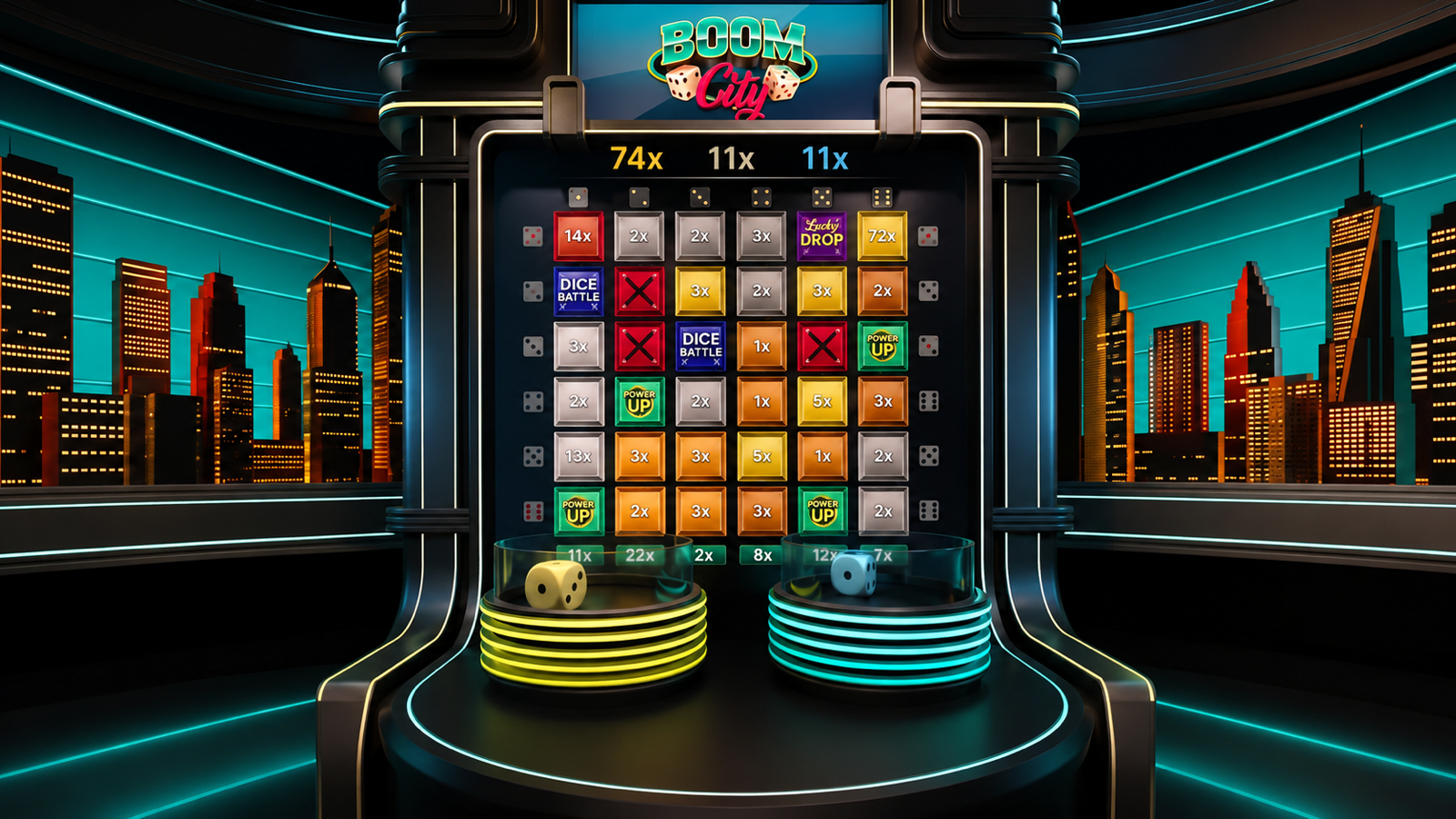
Boom City uses a 6x6 board containing 36 squares, with players placing their bets before the timer expires. Once betting closes, two physical dice are rolled and their combined coordinates determine which square on the board becomes the winning result.
What appears on that position determines what happens next. Regular prize squares provide instant wins, while other positions can trigger Power-Ups or send qualifying bets into one of the three bonus games. There are also Bust positions, which are every bit as welcoming as the name suggests.
I like the grid format because you can see all the possibilities before the dice are rolled. You are not simply waiting for the game to generate something behind the scenes; you can identify where the useful prizes and bonuses are sitting and then watch the two dice gradually decide whether you are going anywhere near them.
The downside is that 36 squares initially make Boom City look more complicated than it really is. Once you understand that one die effectively provides one coordinate and the other supplies the second, everything becomes much easier to follow.
Players bet directly on positions across the 6x6 grid, with each square potentially offering a different outcome. This makes the betting phase more interesting than simply choosing between six identical colours or backing one of a handful of numbers on a wheel.
You can immediately see which positions contain cash prizes, bonuses or other features and decide where you would rather have your money before the dice are rolled. There is still no strategy capable of predicting two random dice, of course, but at least the board gives you meaningful differences between the outcomes you are choosing to back.
Regular instant prizes are divided into Bronze, Silver and Gold, corresponding to 1x, 2x and 5x awards, while the more interesting positions provide access to the features and bonus games.
It is a nice change from game shows where the betting decision amounts to picking your favourite colour and hoping for the best.
Power-Up can randomly enhance squares on the board and is one of the mechanics that stops Boom City's 6x6 grid from feeling completely predictable from round to round.
The feature can increase the value of positions and improve the potential of the board before the dice determine where the winning coordinates will land. This means a relatively ordinary-looking setup can suddenly become considerably more attractive when the right positions receive an enhancement.
I like features like this because they create anticipation before the actual result. Once a valuable square has been improved, you know exactly what you are hoping the dice will produce and can watch the two coordinates develop separately.
It does not require any additional explanation or interrupt the flow of the game either. The board simply becomes more interesting and then the dice get on with deciding whether you are actually going to benefit from it.
Boom or Bust is probably the feature that best demonstrates why Boom City feels more interactive than many live game shows.
Rather than immediately revealing a multiplier, the bonus challenges players to work through a series of levels where the potential rewards increase alongside the risk. Players can make decisions during the feature, while Level Up, Safe Value and Hyper Jump can increase multipliers or help progression through the bonus.
It is essentially a risk-versus-reward game. Progressing further gives you access to more attractive possibilities, but there is always the threat that the next result could bring the whole thing crashing down.
That creates a completely different feeling from the main game. During an ordinary Boom City round you are simply watching the dice determine a coordinate, whereas here you are actually invested in how far the feature progresses and whether continuing is worth the additional risk.
There is something particularly cruel about a bonus game literally putting the word "Bust" in the title, but at least Pragmatic Play is not hiding the terms and conditions.
Dice Battle presents two competing dice and asks players to choose which side they want to back. Each die then receives three rolls, with the aim of accumulating the higher total.
The important difference here is that you are actually making a choice rather than simply entering the feature and watching whatever happens. There is no secret method for identifying which die has been training harder during the week, but choosing a side gives you some ownership over the result.
Watching the totals develop across several rolls also creates natural tension because the outcome is not decided immediately. One side can take an early lead before the later rolls change things completely, which makes Dice Battle feel much more like a miniature game show than a glorified multiplier reveal.
It is simple, interactive and very easy to understand, which is exactly what a bonus like this should be.
Lucky Drop gives players six dice rolls and asks them to choose from six columns containing potential prizes. Each successive roll corresponding with the chosen number can increase the multipliers available within that column.
Again, the important part is that the bonus gives you something to choose before the action starts. Your decision does not suddenly turn Boom City into a game of skill, but it makes the feature feel considerably more involving than simply watching six random rolls and being handed whatever multiplier appears at the end.
The repeated rolls also give Lucky Drop time to develop. A good sequence can gradually improve the potential rather than everything being decided in one instant, which suits the game-show format particularly well.
Of the three bonuses, it is not quite as immediately dramatic as Boom or Bust for me, but it provides another genuinely different use of the dice rather than simply recycling the main game's 6x6 grid.
Boom City has considerably more going on than its basic two-dice setup initially suggests.
The 6x6 grid is an excellent foundation because it creates 36 potential results from a mechanic everybody understands immediately. You do not need to learn what the dice themselves are doing; the only thing you need to understand is how their two results correspond with the board.
Having different outcomes displayed across the grid also makes the betting phase more interesting. You can see where the bonuses and prizes are positioned and choose what you want to chase, even though the dice obviously remain completely random once they are rolled.
The physical dice help too. Watching two real results determine the final square is considerably more satisfying than seeing a random coordinate simply flash onto the screen, particularly when the first die has already put you in the right row or column and you are waiting for the second to finish the job.
Most importantly, the game does not completely surrender player involvement once a bonus appears. Boom or Bust and Dice Battle give you actual decisions to make, even if those choices cannot overcome the underlying randomness.
The board can look rather busy when you first arrive, and ordinary cash results are not especially exciting once you have experienced the bonuses, but there is considerably more longevity here than I would expect from a game fundamentally based around rolling two dice.
Score 8.6/10
This is where Boom City really earns its score.
Pragmatic Play has not created three bonuses that merely dress up the same multiplier mechanic with different animations. Boom or Bust, Dice Battle and Lucky Drop all approach the dice differently and, crucially, introduce some degree of player interaction.
Boom or Bust is the standout for me because the escalating risk gives the bonus genuine tension. The Level Up, Safe Value and Hyper Jump features then add another layer rather than leaving the whole thing dependent on one repeated outcome.
Dice Battle is simpler but arguably more immediately entertaining. Choosing a side and watching two dice fight it out over three rolls gives the feature an obvious objective and makes it very easy to become invested in the result.
Lucky Drop rounds things out nicely by using repeated dice rolls and selectable columns, meaning all three bonuses feel connected to the main game's dice theme without simply repeating the 6x6 grid.
Power-Up deserves some credit as well because it gives ordinary rounds another layer and means the board itself can become more valuable before the result is determined.
I would rather have three genuinely different bonuses like these than six features that ultimately do the same thing with different coloured graphics.
Score 9.0/10
Boom City looks exactly like its name suggests it should: loud, colourful and slightly chaotic.
The large 6x6 grid dominates the studio and gives you an obvious focal point, while the physical dice provide something tangible to watch once betting closes. Pragmatic Play also uses 4K cameras and low-latency streaming, which is particularly useful in a game where following the physical dice is such an important part of each round.
There is a lot of information on screen, but most of it has a reason to be there. The different prizes and bonus positions need to remain visible during betting, while the studio presentation helps distinguish the main game from the three bonus environments.
The presenter-led format works particularly well because Boom City has enough happening to justify the full game-show treatment. As always, I would not score individual presenters because hosts change between shifts, but the live presentation helps tie together the betting phase, dice rolls and bonus transitions.
I do not think it is quite as visually spectacular as Sweet Bonanza CandyLand, but mechanically there is more happening, so Boom City does not need to rely as heavily on scenery and animation to keep your attention.
It is less Willy Wonka and more The Crystal Maze after somebody dramatically increased the construction budget.
Score 8.6/10
Boom City takes something as old as dice and finds a surprisingly original way of building an entire live game show around them.
Using two dice as coordinates on a 6x6 grid is a particularly neat idea because the mechanic is instantly understandable while still creating 36 different possible outcomes. It feels familiar without simply copying a traditional casino dice game.
The bonuses strengthen that identity considerably. Dice Battle turns the dice into competing sides, Lucky Drop uses repeated rolls to develop prizes and Boom or Bust builds an escalating risk game around them. The same basic object therefore behaves differently depending on which part of Boom City you are playing.
That is much more interesting than simply creating another giant wheel and changing the artwork.
The game is not completely revolutionary — dice, grid betting and risk ladders have obviously existed elsewhere — but the way Pragmatic Play has combined them into one live product feels distinctive.
For once, calling something "City" does not just mean somebody put a skyline behind the game and went home.
Score 8.8/10
Overall Rating
8.8/10
Boom City is one of the better examples of a live casino game show using a simple underlying mechanic without producing a simple game.
Two physical dice and a 6x6 board do not sound particularly ambitious on paper, but using the dice as coordinates gives every round an obvious sense of progression. Once the first result is known, you are immediately watching the second die to see whether the final position is going anywhere near the square you have backed.
The changing board makes that more interesting because not every position is equal. Instant cash prizes provide the regular results, while Power-Ups and bonus positions give you much more attractive targets to follow. Pragmatic Play's official launch information lists Bronze, Silver and Gold instant prizes at 1x, 2x and 5x respectively, alongside the three headline bonus games.
Those bonuses are comfortably the strongest part of Boom City. Boom or Bust introduces escalating risk and additional modifiers, Dice Battle gives you a side to choose and follow over several rolls, while Lucky Drop offers another style of progression altogether. They are connected by the use of dice, but importantly they do not feel like three versions of exactly the same feature.
That interaction also gives Boom City an advantage over many game shows. You are never going to outsmart a pair of random dice, but being given decisions during the bonuses makes you feel more involved in what happens than simply watching a wheel spin or waiting for an animation to reveal a predetermined multiplier.
The trade-off is complexity. Boom City is not difficult once you have played it, but the 36-square board, changing prizes, Power-Ups and three different bonuses make the first few rounds considerably less immediately obvious than something like Color Game Bonanza. I think that is a worthwhile compromise because the additional mechanics give it much better longevity once you understand what you are looking at.
Pragmatic Play lists a 20,000x maximum win, which gives the game significantly more top-end potential than many straightforward live dice games. RTP figures published for Boom City are commonly around 96.43%, although I would check the information panel on the version being played because return can depend on the particular bet and configuration rather than assuming one figure applies universally.
Boom City could easily have been two dice, a colourful board and not much else. Instead, Pragmatic Play has built the entire game around finding different ways to use those dice, and that is what gives it an identity of its own.
There is plenty of Boom here. Thankfully, there is considerably more to the City than just the noise.
Overall Rating: 8.8/10.

Color Game Bonanza
Dragon Tiger Live
Bet Behind Pro Blackjack
ONE Blackjack
Auto Mega Roulette
Crystal Roulette
Mega Baccarat
Speed Blackjack