

News
Fury v Joshua: Welcome to Boxing’s £150m Pantomime
Fury and Joshua have been announced for Cardiff, but years of delay, an uncertain title and a promoter row have changed the contest boxing once promised.
27 SEPTEMBER 2026
Head Sports Analyst
About 15 min listen, read by a realistic UK voice.
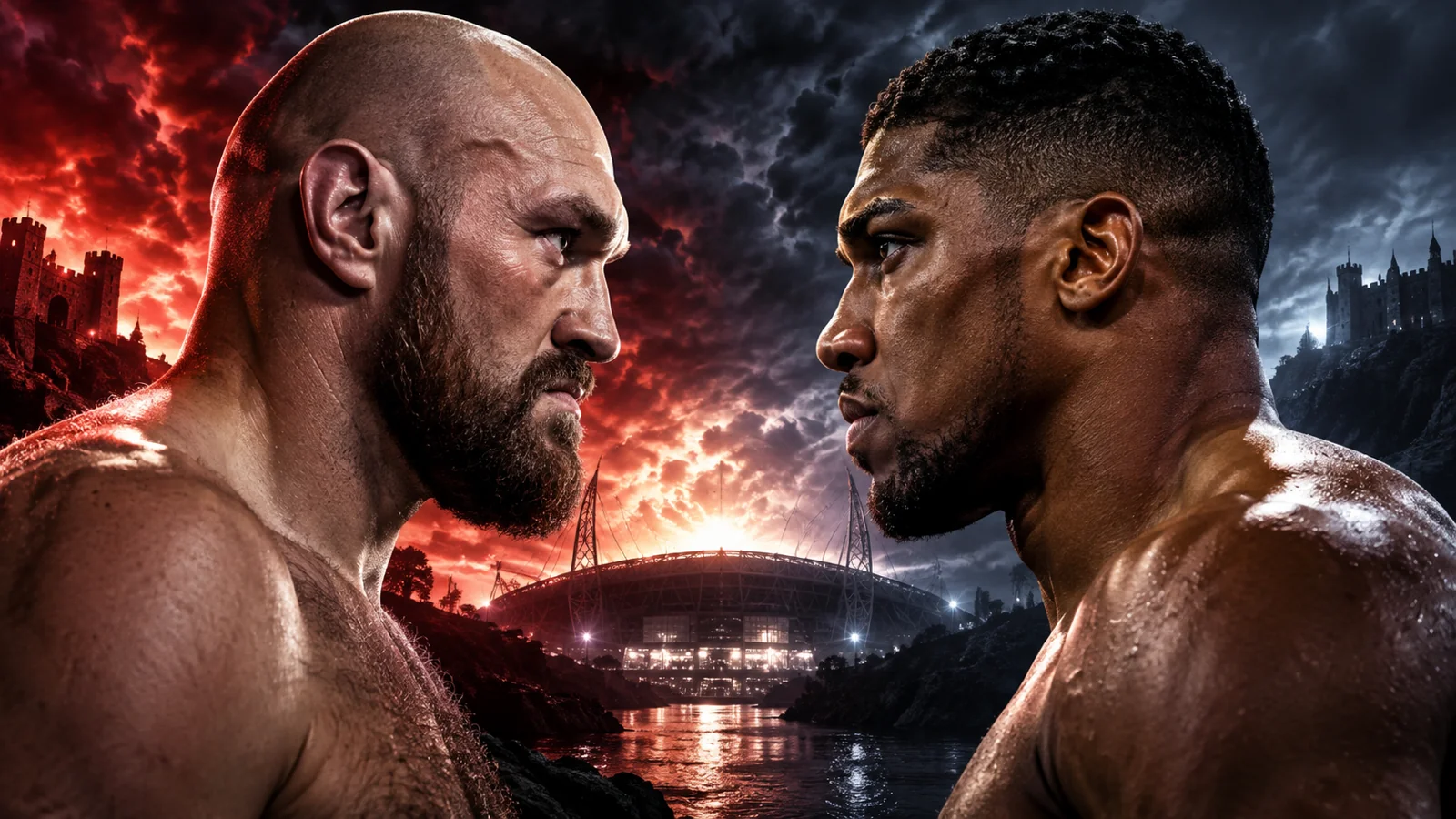
There was a time when Tyson Fury against Anthony Joshua was the fight British boxing desperately needed. Two heavyweight champions, two enormous personalities, two completely different routes to the summit and potentially every meaningful heavyweight belt on the table. It was the sort of fight that should have stopped the country for a night and settled the argument over who really was Britain's outstanding heavyweight of the era.
That time has gone.
Instead, after the best part of a decade of negotiations, failed negotiations, supposed agreements, abandoned agreements, retirements, comebacks, defeats, promotional rows and enough public bickering to sustain several series of a particularly bad reality television programme, Fury and Joshua have been announced for Cardiff's Principality Stadium on 11 December, though a promoter dispute has since cast doubt on the event going ahead as planned.
Naturally, boxing is behaving as though it has performed some extraordinary public service by finally delivering it.
It hasn't. It has delivered years late.
There is no denying the scale of the event. Cardiff will be packed, Netflix will broadcast it around the world and enormous amounts of money will be generated. Turki Alalshikh has described Fury and Joshua as “two of the best heavyweights of this generation” and predicted “one of the biggest fights in boxing history”. Dana White has similarly talked about two of the generation's biggest heavyweights finally colliding.
Commercially, they are probably right. As a sporting contest designed to establish heavyweight supremacy, however, this fight expired several years ago.
That distinction seems to matter less and less in modern boxing.
Even boxing people admit they're past their best
This isn't simply the view of cynical supporters who have become tired of hearing about Fury v Joshua.
Johnny Nelson, a former world champion and one of Sky Sports' most familiar boxing voices, couldn't have been much clearer in his interview with Sky Sports:
“I think both fighters, not just AJ, are way past their best.”
Nelson nevertheless believes their rivalry could allow them to “turn back time for one night only”, which is a perfectly reasonable argument for why the fight could still produce drama.
Tony Bellew has made much the same admission. Although Bellew argues that Fury v Joshua remains relevant and says it would have been a “travesty” had the pair never fought, he has also acknowledged:
“I’m not going to lie, at this stage, they’re both past their best, in my opinion.”
Dave Allen was considerably less diplomatic.
Allen said in an interview before the announcement:
“You know what, I don’t care about the fight at all. I’ve gone way past caring now. I’m sick of talking about it and hearing about it.”
More importantly, his attention has shifted towards fighters such as Moses Itauma, Daniel Dubois, Fabio Wardley and Agit Kabayel.
And there, buried beneath all the hype, is the much bigger problem facing boxing.
Boxing is obsessed with yesterday
Fury v Joshua is not really the disease. It is a magnificent example of the symptoms.
Modern boxing has developed an extraordinary obsession with names rather than sporting relevance. Once somebody becomes famous enough, apparently they never truly leave the sport. They simply move into a permanent recycling programme where retirement is temporary, rankings are negotiable and another enormous cheque is always one sufficiently wealthy promoter away.
Fury is 38. Joshua is 36. Both are former heavyweight champions rather than reigning champions, and both have been beaten twice by Oleksandr Usyk. Joshua was brutally stopped by Daniel Dubois in 2024 and was subsequently dropped twice in the opening round of his comeback against Kristian Prenga before recovering to win in the second. Fury's recent comeback victories over Arslanbek Makhmudov and Mariusz Wach have hardly recreated the sense that we are watching the heavyweight division at its absolute peak.
Yet Fury v Joshua will completely dominate British boxing.
Of course it will.
Fame has become boxing's unofficial fifth governing body.
The sport has spent years complaining that it struggles to create new stars while simultaneously devoting an extraordinary proportion of its promotional oxygen to fighters who became stars ten years ago. Young heavyweights are expected to work through rankings, take dangerous fights, win eliminators and build records, only to discover that the moment an established name decides to return, the entire sport turns around and looks backwards.
Fabio Wardley summed up the generational shift rather neatly in an interview earlier this year when discussing himself, Dubois and Itauma: “The three of us are the next.”
Perhaps boxing should start acting like it.
Apparently we need another heavyweight world champion as well
Nothing better illustrates boxing's capacity for self parody than the controversy surrounding the WBA title.
Murat Gassiev currently holds the WBA heavyweight championship. He won the belt against Kubrat Pulev. Yet reports following the Fury v Joshua announcement indicated that a WBA “Super” heavyweight title could now be placed above Gassiev's championship and awarded to the winner in Cardiff. BBC Sport reported that the title is expected to be involved but said confirmation from the governing body was still awaited.
Gassiev's camp understandably wants to know what on earth is going on.
His co promoter Ivaylo Gotzev put the problem plainly:
“There is already a WBA Heavyweight World Champion. His name is Murat Gassiev.”
Gotzev has demanded clarity about how creating another champion above the existing champion could possibly fit the organisation's own rules and championship structure.
Welcome to boxing.
Only this sport could look at a fight between two former champions, neither of whom currently holds a major world title, and apparently decide that what the occasion really needs is another world title.
Forget earning a championship opportunity by working through contenders. Forget the bloke who already has the belt. Fury and Joshua are famous, the stadium will be full and Netflix is broadcasting it, so apparently somebody has found another championship down the back of the sofa.
If the reported arrangement is confirmed, it would be difficult to devise a better demonstration of why ordinary sports supporters struggle to understand boxing's belts.
And the pantomime has already started
Perhaps the funniest part is that the fight had barely been announced before we were back into precisely the sort of nonsense that has surrounded it for years.
Turki Alalshikh announced the contest by declaring: “The time for talking is over.”
An admirable sentiment.
It lasted about two days.
Fury then went public claiming Joshua and Eddie Hearn were trying to pull out of the fight and blaming the situation primarily on Hearn's “ego”. Fury accused the Joshua camp of making excuses and suggested Alalshikh was already looking for alternative opponents. Matchroom was subsequently contacted for comment.
You genuinely couldn't write it.
A fight that has taken roughly a decade to make apparently couldn't survive its first weekend as an officially announced contest without another public argument over whether it was actually happening.
Johnny Nelson had already called the saga “a bit of a soap opera”.
Soap operas generally have more believable storylines.
And we haven't even reached the first press conference yet.
There will inevitably be face offs, insults, accusations about who ducked whom, arguments about dressing rooms, ring walks, posters and billing. Sky Sports has already noted that Fury being named first in the promotion could raise questions about who walks first, who is introduced first and who gets the home dressing room.
Think about that for a moment.
Two former heavyweight champions approaching the latter stages of their careers have finally agreed to punch each other after years of failed negotiations, and boxing can still find fresh things for them to negotiate.
It's magnificent.
Then there is the small matter of the British audience
The fight is taking place in Cardiff, which should at least mean British supporters finally get the all British super fight on British soil.
Except even that comes with a catch.
The Principality Stadium has confirmed that the event is expected to run into the early hours, while BBC reporting says organisers have considered a very late main event to accommodate audiences in the United States.
So British supporters could spend enormous amounts on tickets, hotels and travel to watch Britain's two biggest heavyweight stars fight in Britain at a time selected partly for people watching several thousand miles away.
Again: boxing.
The people actually sitting in the stadium become part of the television scenery.
The fight could probably begin at breakfast if somebody discovered that was the optimum streaming window.
This should have been for everything
The real frustration is remembering what Fury v Joshua once represented.
At one stage this could have been the fight for heavyweight supremacy. Joshua held the WBA, IBF and WBO championships while Fury held the WBC belt. Britain had two heavyweight champions who between them possessed all four major titles.
The obvious fight was staring everybody in the face.
Boxing couldn't make it.
Then Usyk came along and did what elite competitors are supposed to do: he fought them.
He beat Joshua twice.
He beat Fury twice.
Whatever hypothetical argument once existed about which British heavyweight was the outstanding fighter of the era became considerably less important once the same Ukrainian had defeated both of them twice.
That doesn't make Fury v Joshua meaningless. Rivalries have value beyond championships, and styles can produce fascinating fights even when neither man is number one.
But let's stop pretending it answers the question it would once have answered.
The Fury v Joshua of several years ago could have told us who ruled heavyweight boxing.
The Fury v Joshua of 2026 tells us which ageing British superstar has more left.
Those are not remotely the same proposition.
Boxing's young fighters must wonder what the point is
This is where my sympathy lies.
Imagine being an ambitious heavyweight now.
You train for years. You fight increasingly dangerous opponents. You accept eliminators where one defeat can send your career backwards. You work your way through rankings controlled by organisations whose logic sometimes appears known only to themselves. Eventually you reach championship level.
Then two enormously famous former champions decide they fancy another go and the entire circus moves across town.
The cameras follow them.
The sponsors follow them.
The broadcasters follow them.
The money follows them.
Potentially, even the belts follow them.
And boxing then wonders why it struggles to persuade the public to invest emotionally in its next generation.
You cannot continually tell supporters that today's contenders matter while organising the sport as though yesterday's celebrities matter more.
That doesn't mean Fury and Joshua should turn down the money. Of course they shouldn't. Prizefighting is called prizefighting for a reason, and both men have earned enormous commercial value through remarkable careers.
The criticism belongs with the sport surrounding them.
Promoters will naturally promote whatever generates the biggest return. Broadcasters want audiences. Streaming companies want events capable of becoming global conversation pieces. Governing bodies want sanctioning fees. Everybody's individual decision makes commercial sense.
Put all those individually rational decisions together, however, and you end up with a sport permanently looking over its shoulder.
The circus is becoming bigger than the boxing
That is ultimately what irritates people who still love boxing as a sport.
Boxing has always contained theatre. Muhammad Ali understood theatre better than almost anyone. Prince Naseem Hamed understood entrances, personality and spectacle. Mike Tyson became a global phenomenon. Lennox Lewis and Frank Bruno could command enormous British audiences.
There is nothing inherently wrong with showmanship.
The difference is that the showmanship once helped sell meaningful boxing.
Increasingly, the boxing seems to exist to justify the showmanship.
We now live in an era of influencer fights, exhibition bouts, retired champions returning, cross code contests and enormous events constructed primarily around social media reach. A fighter can spend a decade establishing himself through the traditional boxing system and still discover that somebody with millions of followers can walk into the sport and command greater money and attention almost immediately.
Joshua himself experienced that bizarre new reality when he fought Jake Paul.
Now he moves from that spectacle into another enormous commercial event against Fury.
At some point boxing has to ask what message this sends to everyone underneath.
Perhaps the message is simply the truth: become famous enough and sporting relevance becomes optional.
I'll watch it. Of course I'll watch it.
And this is the contradiction boxing understands better than anybody.
For all the criticism, millions of us will watch Fury v Joshua.
I will.
Cardiff will be packed. Pubs will be packed. Social media will be unbearable for a week. Everyone will have a prediction and suddenly people who haven't watched a non heavyweight fight since Carl Froch knocked out George Groves will become experts on southpaw foot positioning.
There will be genuine intrigue because both men are diminished in different ways. Joshua still possesses frightening power but has shown vulnerability. Fury remains the more naturally adaptable boxer but is no longer the fighter who climbed off the canvas against Deontay Wilder and seemed capable of surviving anything.
As Nelson said, perhaps fighting each other allows them to “turn back time for one night only”.
That possibility is compelling.
But being compelling doesn't make the circumstances any less ridiculous.
Fury v Joshua is simultaneously a huge boxing event and an indictment of how boxing operates. Those two things can be true at once.
It should have happened years ago. It should have happened when championships mattered. It should have happened when both men were closer to their peak. It should have happened before Usyk comprehensively settled the question of who was actually the outstanding heavyweight of their generation.
Instead we get it now, accompanied by arguments about promoters, television times and potentially another world championship belt apparently materialising despite the WBA already having a heavyweight champion.
And two days after somebody announced that “the time for talking is over”, everybody started talking about whether the fight might fall apart again.
You really couldn't ask for a more perfect summary of modern boxing.
Fury and Joshua deserve enormous respect for what they have achieved. They have headlined stadiums, won heavyweight championships and created memories that will remain part of British boxing history long after both have retired.
But boxing has to stop confusing respect for great careers with an obligation to organise the future around them.
There is another generation waiting.
Wardley. Dubois. Itauma. Hrgovic. Kabayel and others are trying to establish what the heavyweight division becomes next.
Boxing should be selling those stories with the same enthusiasm it uses to resurrect old ones.
Instead, the sport remains addicted to the names everybody already knows.
So enjoy Fury v Joshua for what it is: two famous, decorated and ageing rivals finally settling an argument they should have settled years ago.
Just don't swallow the sales pitch that boxing has finally given us exactly what we always wanted.
It hasn't.
It kept us waiting until what we wanted became something else, stuck a global Netflix event around it, may yet attach another version of a world championship to it, and is now preparing months of promotional theatre to persuade everybody that late is somehow better than never.
Dave Allen probably expressed the exhaustion better than anyone: “I’m sick of talking about it and hearing about it. When they get in the ring, I’ll be excited.”
Amen to that.
If the fight does happen, our very own Barry Jones will give his big fight verdict in a special piece on the contest.